
SAS Mediation Service provides a confidential, impartial, and voluntary process to support the resolution of interpersonal conflicts within the university student community. It is designed to promote a positive and respectful environment by encouraging constructive dialogue and mutual understanding.
All mediators are trained and qualified through UK Mediation.
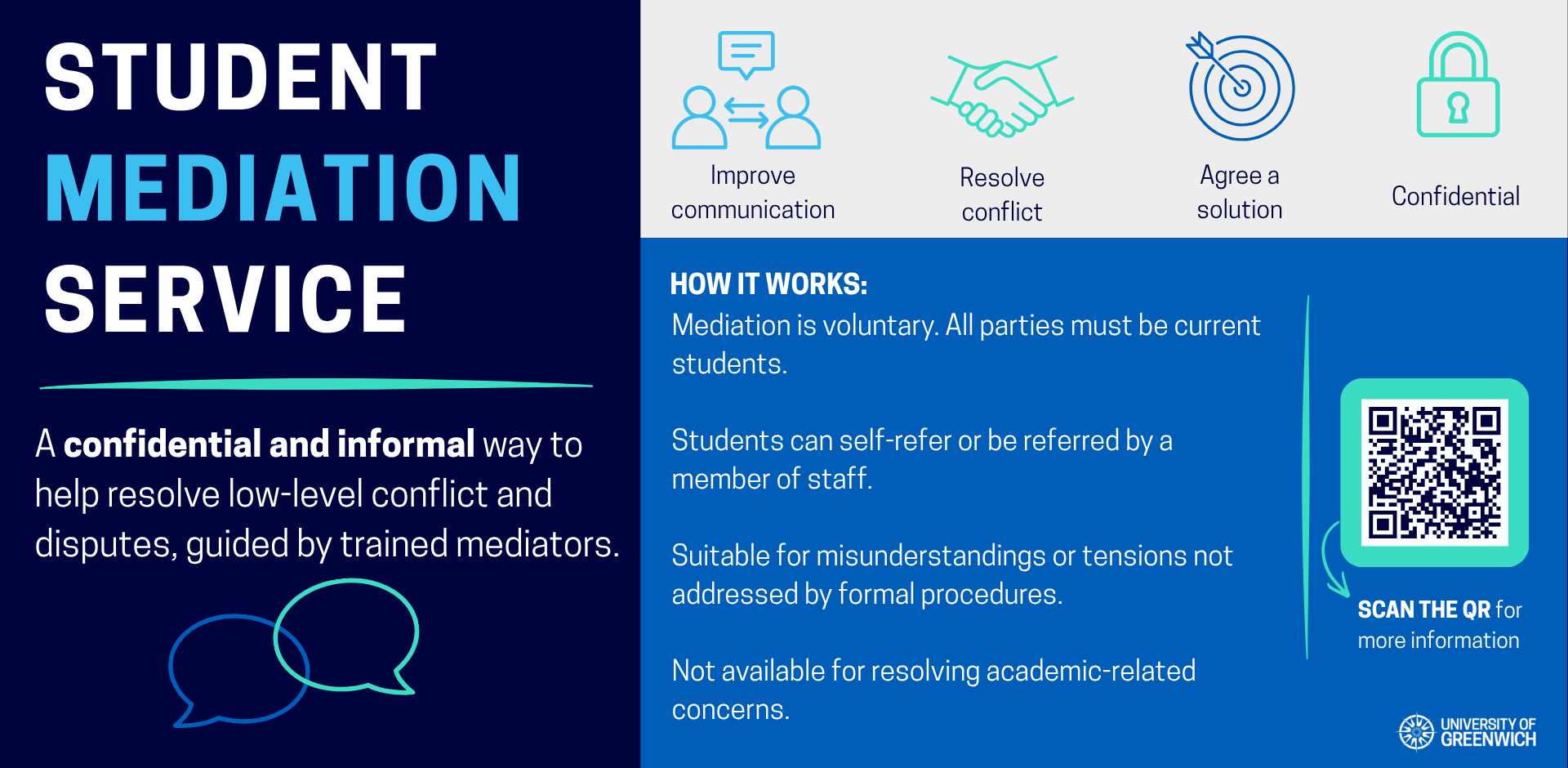
Student Mediation Flyer
The service may be used to address:
- Interpersonal conflicts;
- Communication breakdowns;
- Low-level disputes impacting learning and living environments;
- Misunderstandings or tensions not addressed by formal procedures
The service is available to all students:
- Where an informal resolution process has been identified as a possible solution;
- Where all parties are current students;
- Mediation Service is not available for resolving academic-related concerns, including disputes arising from group projects or coursework.
The service operates on the following principles:
- Confidentiality: All discussions within mediation remain private, except where there is a risk to safety or required by law (see Safeguarding Policy and Student Confidentiality Policy).
- Voluntariness: Participation is entirely voluntary for all parties involved. The student can withdraw from mediation at any point of the process.
- Impartiality: Mediators remain neutral and do not take sides or make judgments.
- Informality: Mediation is a respectful and collaborative process designed to help people resolve issues informally.
- Collaboration: Focus is on finding mutually acceptable solutions and agreements.
- Self-determined: The parties are responsible for deciding the outcomes. Mediators are there to guide them in the process but will not make decisions on their behalf.
Mediation is not appropriate where:
- There are previous or ongoing formal investigations or legal proceedings directly related to the issues at hand;
- Allegations of serious misconduct (e.g., harassment, discrimination, sexual misconduct, criminal behaviour) are involved;
- One or more parties do not consent to mediation;
- Staff-Student and Staff-Staff;
- One party is not a member of the student community;
- The mediator believes that, at any point, mediation is no longer suitable following a breach of the Agreement to engage in Mediation or because the parties do not seem to make any progress.
- Mediation will not be offered in cases where the student has withdrawn, interrupted, is suspended or have completed their studies.
Mediation can be accessed via:
- Self-referral (mediation) - (if you are an active student and you wish to explore mediation as a way to resolve interpersonal conflict with other student(s) - At this stage, you do not need to inform them of your intention to engage in mediation).
- Refer Someone Else (mediation) - (if you are a member of staff and you believe two or more students may benefit from mediation - Before you make your referral you will need to seek consent from at least one party).
If you have any question, please email mediation@greenwich.ac.uk.

Students and staff talking