What is Report + Support?
Report + Support is the University's online platform where students, staff and visitors can disclose how they have been affected by different forms of harassment.
They can disclose something that happened:
- ANYWHERE: on campus, off campus or online
- ANYTIME: recently, non-recently or is still ongoing
- ANYONE: where the alleged perpetrator is a student, staff or member of the public
The Report + Support Team can provide information on reporting options and support available so that you can feel empowered to make an informed decision on what happens next.
How can you contact Report + Support?
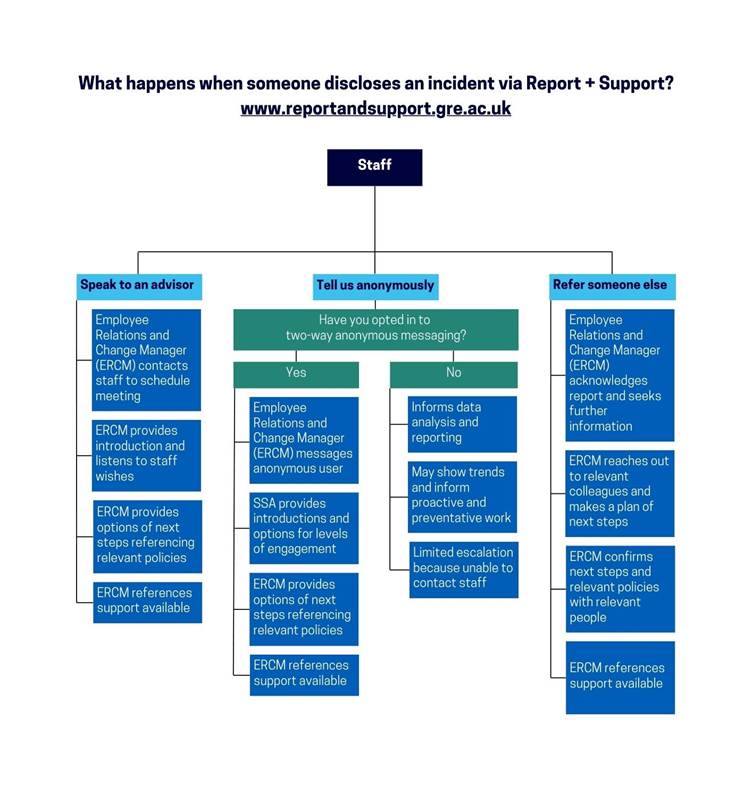
There are three ways you can get in contact with our service:
Choosing to disclose the incident that you experienced with your contact details means that an Employee Relations and Change Manager (People Directorate) will be in touch within two University working days to discuss your reporting options and support available. Please, note that completing a named disclosure does not trigger a formal report or complaint. We will need to speak to you before we can take any further action.
If you believe that a student or fellow staff member may benefit from engagement with the Report + Support and Employee Relations Teams, please choose the refer someone else option instead.
If you believe that a student or fellow staff member may benefit from engagement with the Report + Support and Employee Relations Teams, you can make a referral. You will be asked to share your details so that we can contact you to gather more information, if needed. However, we will always aim to contact the affected person directly and may not be able to share any information or outcome with you, unless the individual consents to it. Alternatively, you can encourage the affected person to contact us directly by completing a speak to an advisor form. Please, note that making a referral does not trigger a formal report or complaint. We will need to speak to the person affected before we can take any further action.
Choosing to disclose anonymously means that, even if we might not be able to help you directly given that you will not be asked to provide your contact details, the information you give us will help us to provide better support to others and inform prevention work across the university. If you complete an anonymous disclosure, please note that this will not trigger a formal report or complaint. If you would like to speak to someone, or need direct support or guidance, or would like to discuss the option of making a formal report or complaint, please choose to speak to an advisor instead.
Before you submit your anonymous disclosure, you will be asked whether you wish to opt in to our anonymous two-way messaging. This allows you to message with one of our advisors whilst remaining anonymous. If you decide to opt in, please do make sure you save the unique code that will be provided as this cannot be recovered if lost. You can log in from the Report + Support homepage using the code to access your report and messages.
What happens next?
If you ask to speak to an advisor, we will be in contact with you within two University working days. Please, check your university email for further instructions.
If you make a referral, we will contact the affected person within two University working days. If needed, we may reach out to you to gather more information.
If you tell us anonymously, we will use the information provided to inform our preventative work. However, if you opt in to our anonymous two-way messaging, we will send you a message to offer specialist information and support, anonymously. You can opt out at any point.
No matter the type of disclosure form you choose to let us know what happened, we will not take any further action until we have been able to speak to you (or the person affected) directly*. This is because we want to empower you to make an informed decision on what happens next. Advisors from the Employee Relations Team can help you understand your options and guide you through the process.
*Should we identify a safeguarding concern (as per our Safeguarding Policy), we may need to escalate the concerns further. However, we would always try to speak to you (or the person affected) first so that we can explain why further action may be needed.
Flowchart